Wind turbines operate continuously in demanding environments, where high mechanical loads, vibration, temperature fluctuations, and limited maintenance access place considerable demands on
lubrication systems. For wind farm operators, turbine manufacturers, and maintenance engineers, selecting the right wind turbine lubrication pump is essential to protecting critical components, reducing unplanned downtime, and maintaining long-term equipment reliability.
A well-designed centralized grease lubrication system helps deliver controlled lubricant quantities to multiple points, reducing the need for frequent manual lubrication inside the nacelle or at other difficult-to-access locations. This article explores the key lubrication requirements of wind turbines and explains how to evaluate a suitable pump and progressive distributor combination for these applications.
Where Do Wind Turbines Need Lubrication?
A wind turbine contains several moving components that operate under different mechanical loads and environmental conditions. Each lubrication point requires an appropriate lubricant type, delivery quantity, and lubrication interval.
Typical grease lubrication applications include:
Yaw bearing and yaw drive: The yaw system rotates the nacelle to align the rotor with the wind direction. Its bearings and associated mechanical components experience repeated movement and significant loads. Consistent grease delivery helps reduce friction, wear, and the risk of premature component damage.
Pitch bearing and pitch mechanism: Pitch systems adjust blade angles to optimize power generation and control turbine operation. Their bearings operate under variable loads and frequent movements. Reliable lubrication is important for maintaining smooth movement and protecting bearing contact surfaces.
Main shaft bearings: Depending on the turbine design and bearing lubrication arrangement, grease may be used for certain main shaft bearing configurations. The lubrication system must match the bearing manufacturer's specified grease quantity and replenishment interval.
Different Wind Turbine Components Require Different Lubrication Methods
Wind turbine lubrication requirements vary depending on the component design and bearing manufacturer's specifications.
Yaw bearings and pitch bearings may use centralized grease lubrication systems to supply controlled grease quantities to multiple lubrication points.
Main shaft bearing lubrication arrangements should be evaluated according to the turbine design, while gearboxes generally require dedicated oil lubrication systems.
Therefore, selecting a lubrication pump requires identifying the actual lubrication points and confirming the specified lubricant type, quantity, and replenishment interval for each component.
Other auxiliary rotating components: Certain mechanical linkages, bearings, and auxiliary drive components may also require centralized grease lubrication, depending on the turbine design.
It is important to distinguish grease lubrication points from oil-lubricated equipment. Wind turbine gearboxes and some generator bearing arrangements generally use dedicated oil lubrication systems. A grease pump should not be selected as a replacement for these systems.
Why Do Wind Turbines Need a Reliable Centralized Lubrication System?
Wind turbines are often installed in remote onshore locations or offshore environments, where maintenance operations can be expensive and difficult to coordinate.
Manual lubrication creates several operational challenges:
Limited maintenance access: Reaching lubrication points inside the nacelle or around rotating assemblies can require additional labor and equipment.
Inconsistent lubricant delivery: Manual greasing may result in variations in lubricant quantity and replenishment intervals.
Equipment wear: Insufficient lubrication increases friction and can accelerate bearing and mechanical component wear.
Unplanned downtime: Lubrication-related failures may require inspections, component replacement, and unexpected turbine shutdowns.
An automatic centralized lubrication system addresses these challenges by supplying grease from a central pump to multiple lubrication points through distribution components and dedicated pipelines.
Instead of relying entirely on manual intervention, operators can establish scheduled lubrication cycles and integrate system monitoring with the turbine's control architecture where supported.
Recommended Wind Turbine Lubrication System Configuration
For wind turbine applications requiring centralized grease delivery, a progressive lubrication system is worth considering.
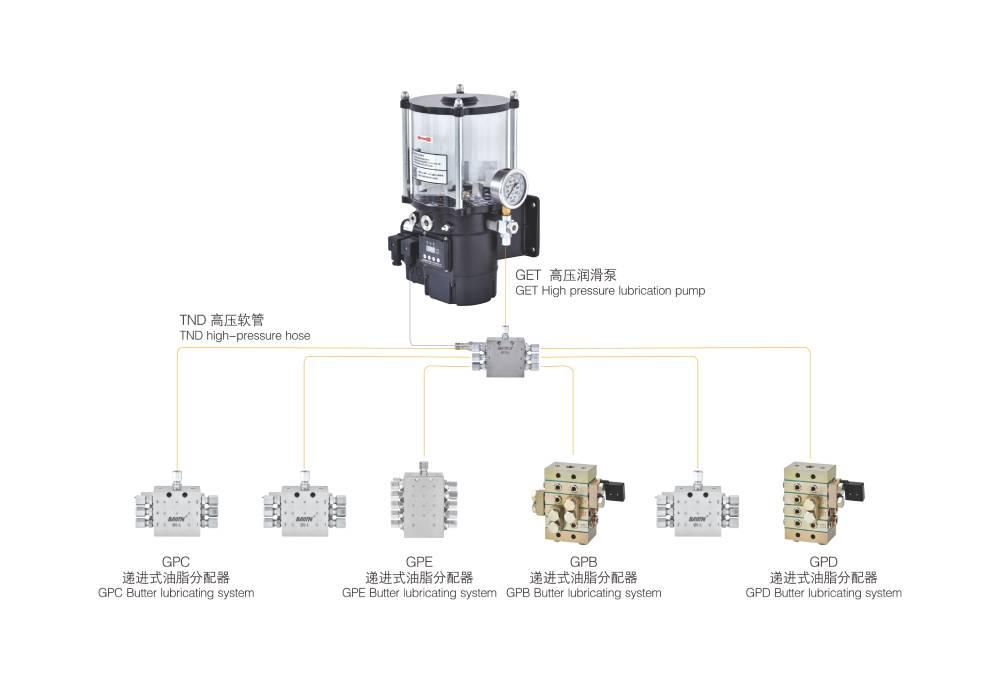
A typical configuration consists of an electric grease pump, progressive grease distributor, lubrication pipelines, fittings, and monitoring components.
The system works through three main stages:
Stage 1: Centralized grease supply
The electric lubrication pump stores and delivers grease under pressure. Its output must be sufficient to meet the combined lubrication requirements of the connected points within the specified lubrication cycle.
Stage 2: Progressive grease distribution
The pressurized grease enters the progressive distributor. Internal pistons move sequentially, delivering a measured lubricant volume to individual outlets. This arrangement helps ensure that connected lubrication points receive their designated grease quantities.
Stage 3: Lubrication monitoring
A suitable monitoring arrangement can track pump operation, pressure conditions, lubricant level, and distributor piston movement. When abnormal conditions occur, the system can provide signals for inspection and maintenance.
For a wind turbine project, the pump and distributor should be selected as a coordinated system rather than as independent components.
BAOTN GET High-Pressure Lubrication Pump for Wind Turbine Applications
For wind turbine applications, engineers can evaluate different GET configurations according to:
Required grease displacement: 2.0, 2.8, or 4.0 mL/min.
Nominal pressure options: 16, 25, or 35 MPa.
Reservoir capacity: 1.5 L, 2 L, 4 L, 6 L, or 8 L.
Control requirements: Host PLC or independent controller.
Monitoring requirements: Low-level and pressure monitoring options.
When integrated with compatible progressive distributors, the GET can supply grease to multiple lubrication points through a centralized pipeline network.
The final configuration should be verified against the turbine manufacturer's lubrication specifications, installation space, operating temperature, power supply, and required grease consumption.
BAOTN GPC Progressive Grease Distributor: Multi-Point Lubrication
The pump provides the pressure and lubricant supply, but a multi-point lubrication system also needs a suitable distribution component.
Its key specifications include:
Maximum working pressure: 35 MPa
Minimum starting pressure: 1.4 MPa
Standard displacement: 0.2 mL per cycle
Maximum lubrication points: 20 outlets
Working temperature: -20°C to +80°C
Applicable lubricant: NLGI 000–2 grease and N68 lubricating oil
The GPC uses a progressive piston mechanism to distribute lubricant sequentially across its outlets. Its metered delivery helps maintain consistent grease distribution among connected lubrication points.
For wind turbines exposed to dust, moisture, and potentially corrosive conditions, the GPC's dust and corrosion resistance is another important consideration.
An optional indicator can monitor piston movement. If a blockage interrupts the progressive sequence, the indicator can help maintenance personnel identify the problem.
Why Use the BAOTN GPC Progressive Grease Distributor?
The BAOTN GPC progressive distributor is designed to distribute lubricant sequentially to multiple lubrication points within a centralized lubrication system.
With up to 20 outlets, the GPC can help simplify grease distribution for applications involving multiple bearing and mechanical lubrication points.
Its progressive piston mechanism allows lubricant delivery to be monitored through an optional indicator. This provides an additional way to identify abnormal piston movement and potential lubrication blockage.
When combined with a compatible GET lubrication pump, the GPC can be evaluated as part of a centralized grease lubrication configuration for wind turbine components.
The number of distributors, outlet arrangement, and individual grease delivery requirements should be determined by the actual turbine lubrication diagram.
How to Select the Right Wind Turbine Lubrication Pump?
Choosing a suitable wind turbine lubrication pump requires more than comparing maximum pressure ratings. Engineers should evaluate the complete lubrication system against the turbine's operating conditions.
Calculate the total lubrication demand
Identify all grease lubrication points, their required grease quantities, and replenishment intervals. Calculate the total grease demand per cycle before selecting pump displacement and reservoir capacity.
Match pump pressure to system resistance
Consider pipeline length, pipe diameter, fittings, distributor starting pressure, grease consistency, and ambient temperature. The selected pump must provide sufficient pressure at the distributor without exceeding the allowable pressure of any system component.
Although both the GET and GPC support pressure ratings up to 35 MPa, this does not mean every installation should operate at 35 MPa. The actual working pressure must be determined by the complete system design.
Check the number of lubrication points
The GPC supports up to 20 outlets. If a turbine requires more lubrication points, engineers should evaluate multiple distributors or a different distribution arrangement, considering progressive sequence and flow requirements.
Consider environmental conditions
Check the expected operating temperature, moisture exposure, dust, corrosion risks, vibration, and available installation space. The GPC's specified temperature range is -20°C to +80°C. For applications outside this range, additional engineering confirmation is necessary.
Evaluate monitoring and maintenance requirements
For remote wind farms, low-level alarms, pressure monitoring, and distributor cycle detection can help reduce inspection effort and identify lubrication problems earlier.
Build a More Reliable Wind Turbine Lubrication Solution with BAOTN
A reliable wind turbine lubrication system depends on matching the pump, distributor, lubricant, and control strategy to the actual requirements of the turbine.
The BAOTN GET high-pressure lubrication pump provides configurable grease supply, multiple reservoir capacities, and flexible control options. Combined with the BAOTN GPC progressive distributor, which supports up to 20 lubrication outlets and a maximum working pressure of 35 MPa, it offers a potential configuration for centralized grease lubrication of multiple turbine components.
However, final selection should always be based on the turbine's lubrication diagram, bearing manufacturer's specifications, required grease consumption, and environmental conditions.
Looking for a suitable wind turbine lubrication pump or a customized centralized grease lubrication solution?
Contact BAOTN to discuss your application requirements, lubrication points, and system configuration.